Survival Thai · No. 03 · YES & NO
How to Say Yes and No in Thai (and 'I Don't Understand')
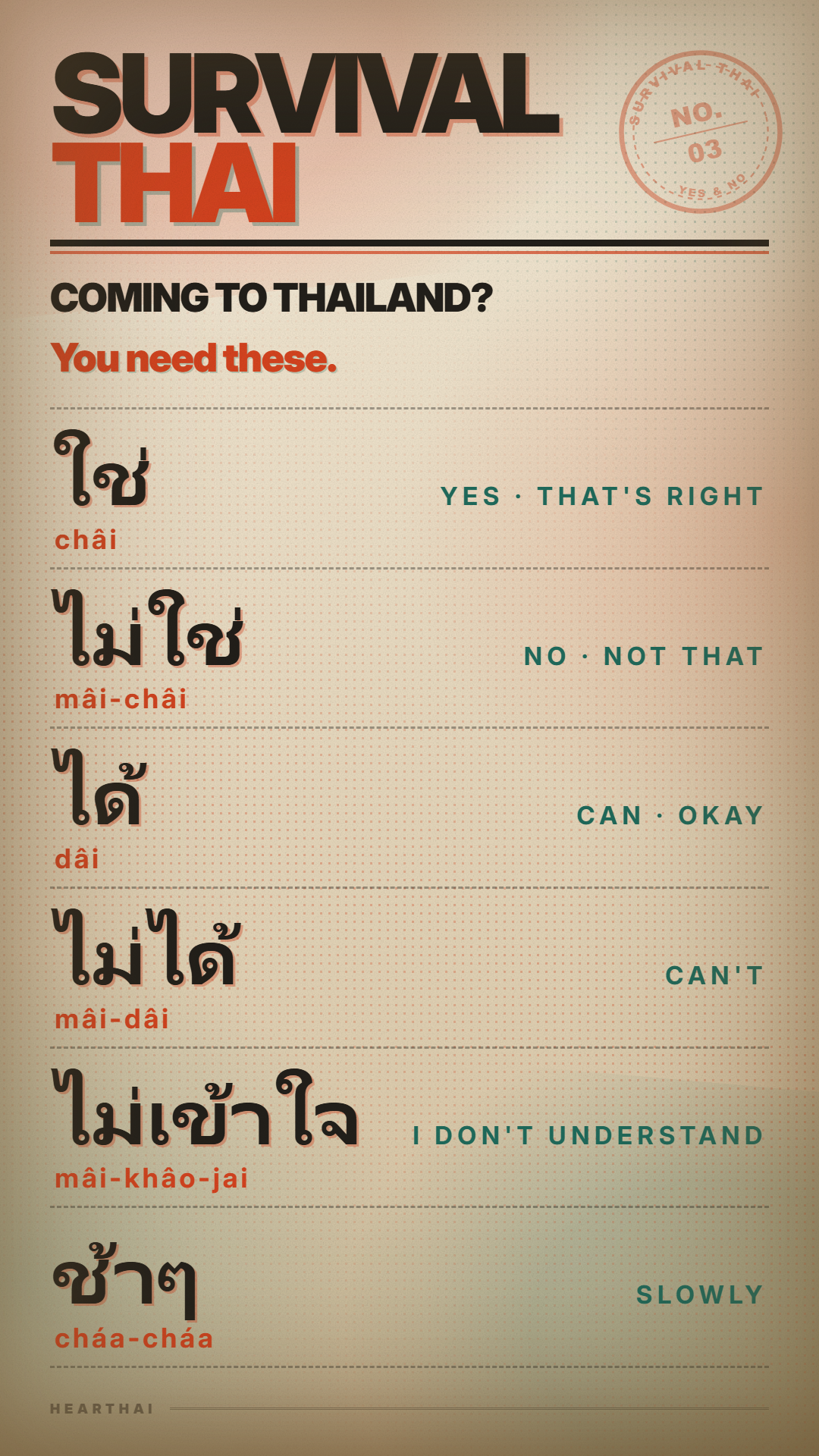
Yes is ใช่ (châi), no is ไม่ใช่ (mâi-châi), and the sentence that saves you most is ไม่เข้าใจ (mâi-khâo-jai) — I don't understand. Six words that buy you time.
The words on this page
Tap any word to hear it. 4 of 6 have audio; tap the Thai to open its full pronunciation page.
Yes is ใช่ châi. No is ไม่ใช่ mâi-châi — literally the same word with a "not" bolted on the front. Okay or can-do is ได้ dâi, and its negative is ไม่ได้ mâi-dâi.
The one that actually rescues you, though, is ไม่เข้าใจ mâi-khâo-jai — "I don't understand" — followed by ช้าๆ cháa-cháa, "slowly."
Thai does not have one word for yes
châi is closer to "that's right" than to a general-purpose yes. It confirms that a statement is correct. Ask a Thai speaker a normal question and the answer often comes back as the verb repeated instead — you ask "is there any," they say "there is." That is a yes.
You do not need to produce that yet. Just know that a reply which does not contain châi is still very likely an agreement, so don't stand there waiting for a yes that isn't coming.
Your politeness particle also does the job. khráp or khâ said alone, with a nod, is a complete and perfectly polite "yes, understood" — which means you already own a yes from the politeness page.
dâi is the workhorse
dâi means can, may, is possible, fine by me. It answers "can you take me to the pier," "can I pay by card," "is 200 okay." One syllable, huge coverage.
mâi-dâi is the refusal, and here is the useful part: it usually lands softer than a flat no. It says this isn't possible — or this isn't allowed — rather than I don't want to, which keeps the exchange friendly even when the answer disappoints you.
What do I say when I've lost the thread?
mâi-khâo-jai, then cháa-cháa. In that order. The first stops the flow, the second asks for it again slower. Almost everyone will slow down, and many will switch to gestures and numbers on a phone screen, which is what you wanted anyway.
The mistake is nodding through. Nod through a taxi negotiation or a pharmacy conversation and you end up somewhere expensive with the wrong medicine. Two words, said cheerfully, cost you nothing.
The pattern hiding in this list
Look at the pairs: ใช่ châi becomes ไม่ใช่ mâi-châi. ได้ dâi becomes ไม่ได้ mâi-dâi. And "understand" becomes ไม่เข้าใจ mâi-khâo-jai. The same little mâi- sound in front, every time, turning the word off.
That is one of the first real pieces of Thai grammar you get for free, and it is worth noticing now, because you will meet it again on the food pages — the same front-loaded mâi- is what turns "spicy" into "not spicy."
Takeaways
châi= that's right;mâi-châi= no, not that.dâi= can / okay;mâi-dâi= can't — softer than a flat refusal.- A Thai yes often comes back as the repeated verb, not as
châi. mâi-khâo-jaithencháa-cháais the escape hatch. Use it early, not after you're lost.- Add
khráporkhâto any of these — a baremâi-châiis blunter than you mean it to be.
These are 6 words.
HearThai Academy trains your ear on 25,000.
Premium audio for every word, the tone mechanics behind it, and games that make your ear do the work. Start free — no card.
Create a free accountFree trial. No card required.