Survival Thai · No. 02 · POLITENESS
How to Say Hello and Thank You in Thai (Politely)
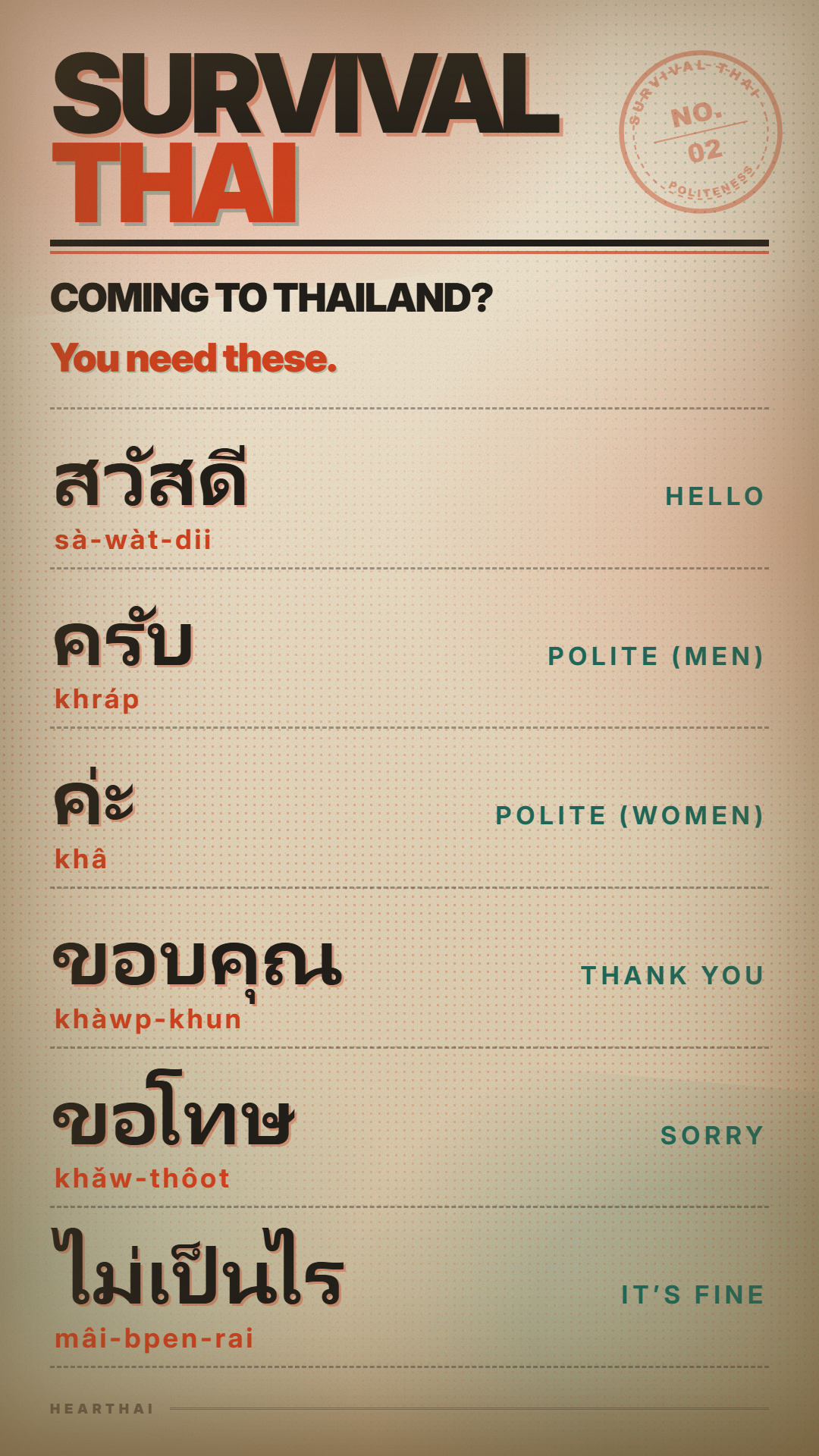
Hello is สวัสดี (sà-wàt-dii), thank you is ขอบคุณ (khàwp-khun). Add ครับ (khráp) if you're a man, ค่ะ (khâ) if you're a woman. Here's why that ending matters.
The words on this page
Tap any word to hear it. 5 of 6 have audio; tap the Thai to open its full pronunciation page.
Hello is สวัสดี sà-wàt-dii. Thank you is ขอบคุณ khàwp-khun. Then you add one small word to the end: ครับ khráp if you are a man, ค่ะ khâ if you are a woman.
So a man says sà-wàt-dii khráp. A woman says sà-wàt-dii khâ. That ending is not optional decoration — it is the difference between sounding like a guest and sounding like an instruction.
The ending goes by your gender, not theirs
This is the mistake almost every beginner makes. khráp and khâ describe the person speaking. A man says khráp to everyone — men, women, kids, the hotel desk, the police officer. A woman says khâ to everyone. You never switch it to match who you are talking to.
Stick it on the end of everything for your first month. Hello, thank you, sorry, yes, no, a single pointed finger and a number. It costs you one syllable and it changes how the entire exchange feels.
The one shift women should know: asking versus telling
khâ is the statement form — the one on the card, and the one you will use most. When a woman asks a question, that same particle lifts to a high tone: khá. So "thank you" is khàwp-khun khâ, but "how much?" is thâo-rài khá.
Men have it easier: khráp doesn't change shape. And nobody will misunderstand a woman who uses khâ on a question — it just marks you as new. Learning the pair now costs you nothing and saves you unlearning it later.
Do I really need the polite particle?
Yes, more than you need correct grammar. Thai speakers will forgive a mangled tone and a missing verb without blinking. What they notice is a sentence that arrives bare. Without the particle, a perfectly friendly request can land flat or clipped — not offensive exactly, but cold, the way "give me water" reads next to "could I have some water."
Sorry and excuse me are the same word
ขอโทษ khǎw-thôot does both jobs. Squeezing past someone on a packed BTS platform, stepping on a foot, interrupting to ask a question, apologizing properly — all khǎw-thôot. It is also the polite way to get a server's attention across a room.
The most useful word on this list
ไม่เป็นไร mâi-bpen-rai — "it's fine." It answers a thank-you, waves off an apology, tells someone not to worry about the broken thing, and closes a small misunderstanding without anybody losing face. It is the closest thing Thai has to a universal social reset button, and you will hear it several times a day.
Takeaways
sà-wàt-diihello,khàwp-khunthank you,khǎw-thôotsorry and excuse me.khrápfor male speakers,khâfor female speakers — based on you, never on them.- Women:
khâwhen you're telling, the higherkháwhen you're asking.khrápnever changes. - Put the particle on the end of everything, including one-word answers.
khǎw-thôotis both an apology and the polite way to get attention.mâi-bpen-raihandles thanks, apologies, and small problems all at once.
These are 6 words.
HearThai Academy trains your ear on 25,000.
Premium audio for every word, the tone mechanics behind it, and games that make your ear do the work. Start free — no card.
Create a free accountFree trial. No card required.